|| Reveal Your Contact Lens Approach with CooperVision ||
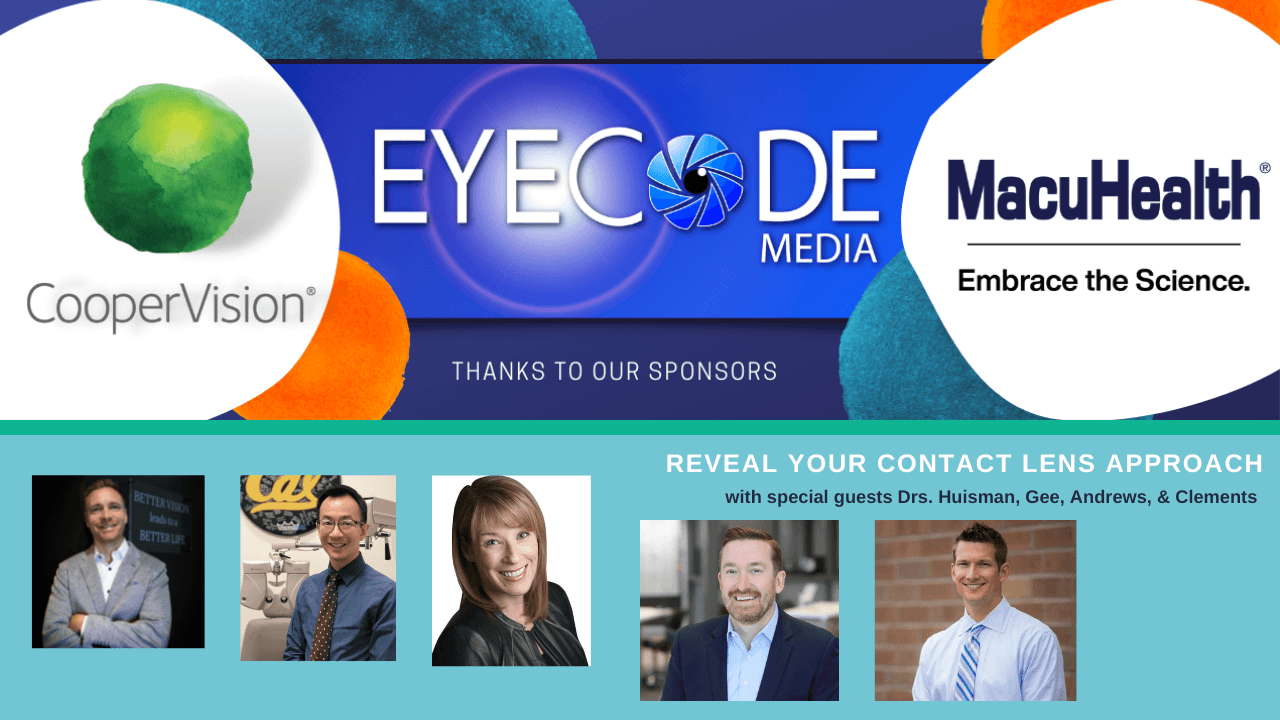
On this episode we talk to Dr. Christopher Gee, Dr. Ethan Huisman, Dr. Jeff Clements, and Dr. Michele Andrews about the MyDay Lens, the Reveal Lens, and the Multifocal Toric Lens from CooperVision. We really got into the granular nature of our practice and how we approach contact lens fitting so that it’s good for the patient and profitable for the practice.
Get CooperVision Lenses in your practice here!
Show Sponsors:
Podcast
Dr. Chris Wolfe: [00:00:00] Hello and welcome to Christopher Podcast on I Code Media. Today I had a great conversation with Dr. Christopher G, Dr. Ethan Heisman, Dr. Jeff Clements, and Dr. Michelle Andrews about. Uh, the my day lens, the reveal lens, multifocal a toric lens, and really kind of get got into the granular nature of our practice and how we approach contact lens fitting so that it’s, uh, good for the patient, profitable for practice.
And I really have fun with this conversation. Please enjoy our conversation and as always, be sure to subscribe to the podcast, write a review, share it with your friends, and support those who support us. So today I wanna talk about the my day multifocal for just a second. It has been a really great thing in our practice for our patients who are presbyopes of all areas.
But you know, those tricky presbyopes are always the ones that are kind of emerging where they don’t want to give up any of their far away vision. But they’re [00:01:00] having some struggles up close. And so what, uh, the Mighty Multifocal has been able to do for us is to allow those patients to transition into a multifocal more easily.
And then as we have those patients progress into other levels where they need more ad powers, It’s been a nice smooth transition. So the ultimate hurdle that we’ve seen in our practice before the my day multifocal was that we’d have patients who would resist any transition to a multifocal lens because of that distance blur.
We just haven’t seen that. So if you haven’t started using my day multifocal in your practice, I would encourage you to start check it out. Uh, contact, reach out to your Cooper reps for those trial lenses, uh, and commit to MyDay multifocal for your patients. I think they’re gonna like it. If you haven’t checked out Macia Health yet for your patients in category one through category four, I think there’s a lot of evidence that you should be considering.
The first is, if we just look at a Reds two and what they, they talk about Maci Health is a, So for patients in category three and category four, um, [00:02:00] AMD Macia Health has a great option for them that follows that entire, um, that entire protocol. And it also add. Meso Z is anine to the mix, which if you look at some of the evidence, I believe, shows me that it’s going to thicken the macular pigment better than without meso zanine.
It also uses the A, correct a reds two dose of zinc, uh, at 25 milligrams. And so you don’t have to worry so much about the potential side effects of zinc. The other thing to to think about, and it’s beyond the scope of this, although you’ve probably heard me talk on other podcasts, is that in patients in category one and two, there may be some additional benefit.
Uh, to supplementing them with something that may be a little bit less than the A Reds two, so you don’t have to add as much to it. And that’s where I use the Maca Health LMC three. And so I think if you haven’t done this yet, I’d consider Maci Health in your practice and for your patients. And it’s been great for my patients and, um, and we really feel like we can have the ability to, uh, help those patients in all categories of macular degeneration.[00:03:00]
Thanks everybody for jumping on today. I, uh, I’m excited to have a conversation. You know, for the listeners, I think it’s important to know that, um, we’ve got a couple different participants here. We’ve got Chris G uh, who practices just outside of San Francisco, um, Ethan Heisman, who practices outside of Des Moines.
Jeff, I didn’t get a chance to ask you where, uh, where do you practice? Jeff Clemens? Where do you practice? Just north of Madison. Yeah, yeah, yeah, I knew that. Yeah, I knew that too. So, uh, and then we have Michelle Andrews who, um, who is always such a grace gracious guest and she has all these kind of insights within the profession that a lot of us clinicians don’t get to see all that much.
And so I think it’s really helpful to have your perspective as well, Michelle. And I think it’s also important from a disclaimer standpoint as while all of, all of the docs on here, um, our, uh, our clinicians own their own practices, um, except for Michelle. Um, They’ve been compensated for their time today to be here.
And so I think that’s important for me to mention as well. But I think they’re gonna give you [00:04:00] honest opinions about how things have been, uh, working in their practice for, you know, from a standpoint of when we talk about multifocal lenses specifically, uh, My day and reveal multifocal, um, my day and Reveal Toric, and then also the my day and Reveal Sphere.
So I wanna kind of get right into it. The first thing I’m gonna kind of pick your brain about, um, Michelle, is this idea of private labeling. And maybe Chris, you can jump in on this as well, but Michelle, from your perspective, when you think about why would Cooper want to offer private labels as opposed to just saying, Look, everything’s my day, we’re gonna go all in on a brand.
What, what, uh, how does the con contact lens company. , um, kind of wrap their minds around that and take that approach. Yeah,
Dr. Michele Andrews: so the idea of a private label has really evolved over time. We now refer to them as, as customer brands, and that, that really speaks though to the evolution of what, how private label started and really what it means now because really now [00:05:00] Chris, it’s driven by our customers who see the value in having a product that is brand.
in a way that they choose to brand it that represents high quality and also gives their customers an opportunity for loyalty and retention. And so we see it as a great opportunity to support the needs of our customers when they’re trying to achieve those two things, which is a really important in a clinical practice,
Dr. Chris Wolfe: you know?
So then, you know, I think when I think about the pushbacks, and, and this might be for you, uh, Dr. Andrews, but also it might be for the rest of the docs on the panel. Is when I talk to some docs about using a customer brand or a private label, one of the things, first of all that I, I think is kind of sticky is that like 97% of households have a, a customer brand in the household.
So people are already aware that they exist. They’re already choosing brands that are, that are private label or customer branded. But one of the, the, the [00:06:00] pushbacks I get from doctors when they have access to one of those customer brands is they say, You know, I don’t want to. Um, make my patient feel like they have to get their, their materials from me.
I want to show them that they have, have a good value. I wanna be able to, and, and it’s almost like the, the, their perception that the pa, the doctor’s perception of how the patient will think about them if they have a customer brand, Dr. G or, or Dr. Heisman or Dr. Clements. Uh, any thoughts about that? How you kind of overcome that?
Or, or does that even go through? For
Dr. Christopher Gee: me, I think it was more of a problem with my own thinking when I was slow to jump on board with this. Um, I personally felt so we make a point to be very transparent in everything we do, transparent in our fees, transparent in, uh, just how we process data. And again, problem with my head, this felt less transparent for whatever reason.
Does it [00:07:00] feel
Dr. Chris Wolfe: less ing? And so when I find, when you go to, let’s say, Target and by Method Cleaner, does, does that feel bad to you when you do that? Sorry, the audio cut out for me could repeat the question. So, So if you were go, if you were just for yourself, I’m just trying to make you a customer, right? If you went to Target and bought Method brand or whatever their, did that ever make you feel bad as a customer or make you feel like it was not up?
Uh,
Dr. Christopher Gee: no. No. So
Dr. Chris Wolfe: why is it d why do we think it’s different from a, from a doctor’s perspective? From the
Dr. Christopher Gee: doctor’s perspective, I felt like there was some sort of, maybe like a bait and switch or a, here’s the same product, but under a different name so you don’t find it somewhere else. But let, I got over this.
Yeah. How did you get over it? Right. And I did it in baby steps and when I first got over it, I started just putting the name, the, the customer brand name on the prescription, and I put the [00:08:00] national, whatever we call it, the original name, in parentheses. And this was my way of saying, well, you know, here’s what’s gonna, here’s what it’s gonna say on the box.
But fully transparent, if you decide to go somewhere else, this is what you would look for. And I wouldn’t say that out loud, it would just be
Dr. Chris Wolfe: there on paper. So it’s interesting that you, that you’ve done that. That’s exactly what we did. Instead of using parentheses, we did a slash, you know, so it would say Reveal slash my day.
Dr. Ethan Huisman: Uh, we never did the parentheses. Um, you know, I became, Um, a Vision Source member about six months after I’d opened my practice. So I had a very short lead time of not being Vision Source. And then once, uh, once we did join Vision Source, we just kind of moved full in on the, on the customer branded lenses and we’re very successful, had great patient acceptance.
And there are few isolated times over the years where patients would ask for the national brand and things like that. But overall, [00:09:00] we never. Had any kind of resistance or pushback or anything. And so we’ve never done the flash parentheses or anything like that on the prescriptions. Seems
Dr. Chris Wolfe: to me that most of this is, is kind of our perspective.
Dr. Clemens, what do you think? What’s, what’s been your experience in your practice? Same thing.
Dr. Jeff Clements: Um, I’ve never used it as a barrier. I have a Costco across the street from my office, so the rare time where someone will be like, Hey, they said this is the same as their brand name. What’s up with this? And again, this is only a handful of times I’ll say, Well this is part of my buying group.
This is how we can offer you a better rate. Here’s your rebates, and
Dr. Chris Wolfe: then we get this sale because we can beat it. Yeah, yeah. Now, so I, I may come back to this, um, but I also want to pick Dr. G I wanna pick your brain cause we’re gonna start with kind. I wanna talk about how the sphere works. Mainly how the sphere works in relation to being able to leverage the options we have within a my day or reveal lens where we.
You know, when you have the full suite [00:10:00] of, of types of lenses for that specific type of material, I think it allows us to, to use more of even the sphere than we may have otherwise. So I do want to come back to some of those points, but gy, um, I know you do a lot of, you have, you have a lot of presbyopic patients and a lot of patients who, um, who are presbyopic contact lens patients.
And, and so can you gimme a little bit of your perspective on, um, on the MyDay reveal, uh, multifocal and how you’re using. Yeah. You know,
Dr. Christopher Gee: it’s funny because I actually have a very young demographic, really, uh, compared to other places. Like where Yeah. How can they afford, afford to live there, live there. , uh, tech, the answer is tech.
We live in suburbia with a short commute to, to Silicon Valley, um, and we have cheaper homes here, so they’re young, young families. , but I get a lot of, a lot of emerging presbyopes. Uh, and I, I still, we still get our fair share of, you know, over fifties. Um, but the answer to your question is that, uh, I, I’d been [00:11:00] fitting a lot of reveal before multifocal came out already.
Um, and I think a lot of the difficulty with that some people may have with transitioning to a multifocal is that it feels like a brand new fit, right? Like starting from scratch, even though it’s, the material’s the same, even though the fit is probably gonna be really similar, it feels like a brand new fit.
You mean the doctors feel that way and that is correct. and reveal multifocal. Not a lot of calculations you have to do. I don’t know if there’s any calculations you have to do. You’re, you’re not having to choose D lenses or n lenses. You’re not having to choose, you know, different ad powers, uh, per se. Uh, the, the fitting guide just made it so simple that my, my brain goes through nothing.
Compared to a spherical fit. You know, I’ve
Dr. Ethan Huisman: been my,
Dr. Chris Wolfe: other than dominant, I non-dominant. Do you, do you charge a different, um, cardiac lens evaluation fee for a patient who’s a early presby or a Presby versus a non presbyop?
Dr. Christopher Gee: Um, I charge [00:12:00] one flat fee, uh, if a patient is already in a brand of lenses. Uh, and then I’ll charge a refit if I have to.
Fitting changes or design changes.
Dr. Chris Wolfe: And so, Okay. But I think your question is, if I had to reveal
Dr. Christopher Gee: Spear yes. Would I charge a refit to get him into reveal, uh,
Dr. Chris Wolfe: multifocal? Yes, I would. You know, I think one of the things that I think is a barrier, and, and maybe this is the case for, uh, for Dr. Heisman and Dr. Um, Clements, but I think a barrier for what you’re describing Chris, was, um, is, is our own barrier, right?
If, if I. Charging for my time and my expertise and what that’s gonna cost for me to bring, bring that patient back potentially if I needed to do a follow up, then I’m less inclined to, to want to recommend different things. And so you, you sort of have removed that barrier from a standpoint of, Look, this is my expertise.
Do you think there’s still a lot of guys that aren’t cha uh, charging refit, uh, fees or charging different fees when a patient needs a different type of, uh, lens? . [00:13:00] Wow. I don’t, I don’t
Dr. Ethan Huisman: know that I could speak to that. I, I imagine there are, I
Dr. Chris Wolfe: don’t know who they are. Yeah. But, but it hasn’t been your experience where, um, by and large people are doing that anymore?
I don’t think in our vision source circles that I run with, most of them are doing that. Sometimes I, I, I talk to these guys that are not in Vision Source, and I think, and it, and it, you know, it can happen to anybody. It can happen in a vision source, but I generally think when I talk to them, I’m like, Oh, you’re not charging a, or I listen to the fees that they’re charging.
What, what are you doing? You know, it’s become a pure commodity for them, um, or for the patients. Yeah. So then Chris, my, you know, the only time, Go
Dr. Christopher Gee: ahead. Go ahead. The only time that comes up is when the patient says, Well, I’ve never been charged a contact lens fitting fee before, and we
Dr. Chris Wolfe: don’t know. That’s not true.
I hope not. I hope that’s not true. Um, so the, the then, you know, I think you’re right. That’s been my experience as well as this, this progression from patients who are, you know, non presbyopic to emerging presbyop. The reveal [00:14:00] multifocal for me has been like a slam dunk. Uh, it’s been a very easy transition.
What ha what about those patients that, and are, is there any other nuance or learning that you have where a patient, let’s say they’re 50, they’ve, they’re this, they’re, they know the, the challenging one. They’re TROs, they want to be able to see well up close, and they need a, you know, they need a plus two ad.
So any learnings that you’ve got for, for us, um, on those patient.
Dr. Christopher Gee: I really lower expectations from the the get go, get go. Right. And, and I have that whole conversation about how multifocals are great. Uh, they have been a game changer. I have lots of patients in multifocals. Uh, but, but let’s be real.
There’s a compromise. Just like progressive glasses, Lenses have a compromise where you have to figure out where you’re, you know, trying to look through, just like putting reading glasses over distance. Contact as a co. Just like having one I far, one I ear is a compromise. There is a compromise with every multifocal solution.
Um, and for the right person, which I believe is the vast majority [00:15:00] of people, uh, the compromise, the visual compromise in these multifocals is significantly less than the others. Um, and by the time I’m in with my done with my short spiel, I mean, I don’t know what they’re expecting, like halos, they’re expecting.
Uh, very difficult transition. They’re expecting days to get used to it, and so by the time it’s on their eyes and they look at it like, Well, I can see that. I can see this. This is fine. Yeah.
Dr. Chris Wolfe: And I say great. Yeah. You know, I think, again, we’re kind of talking about sabotaging ourselves, but, um, you know, one of the things that I always we’re kind of ingrained into is to, uh, want to get that 20 whatever number.
You know, Jeff, I, I don’t, and, and even Ethan, you know, we’re kind of built into this, uh, okay. A patient comes in and the first thing we want to do is stick a card in front of them to see how they’re seeing up close and stick a chart in front of them to see how they’re seeing far away. And I think that sabotages things so often where you get a patient coming in [00:16:00] and I’ll, I’ll walk in my pretest, my tech has already gotten, um, visual acuity, and I’ll say, How’s things going?
And they’ll tell, . Oh, I was doing great until I looked at this chart and I’m like, Oh golly, why did we do that? You know? And I don’t know. Have you guys changed, Jeff and, And Ethan, have you changed the way you approach multifocals or even your contact lens fits? Go ahead. Yeah,
Dr. Jeff Clements: especially with multifocals, the near expectations is why we’re fitting it into a multifocal, but instead of having them look at the near card, I’m making them look at their phone.
A lot of times they’re blown it up anyway. So I’ll just say, Pull up a text or an app that you like to use, How’s it feel? And then they’re not trying to strain for a 2020 line. I go
Dr. Chris Wolfe: for everyday lifestyle. So then documentation in your chart. Again, if, If I’m thinking about this, There’s still this gut reaction for a lot of us that says, Boy, I need to put something in the chart for visual acuity.
Otherwise, if that patient gets in an accident, et cetera, et cetera, you know, [00:17:00] I, I don’t know how the Well they saw. What’s your response to that, or how do you, how do you mitigate that fear? I try to give ’em the
Dr. Jeff Clements: phone first and then let’s just see how far you can go, and then I’ll push ’em and then, so I will document it that way.
But, uh, explain that I can make them look at little letters all day long, but I want to know their real
Dr. Chris Wolfe: world experience before they follow up. Ethan, what do you think? Anything different? No, I agree
Dr. Ethan Huisman: very much with what Jess said about using what the patient wants to see. They want to see their phone.
They don’t need to see six point type on a piece of paper because for the most part we don’t do that anymore. So we want ’em comfortable on the phone. We want the patient comfortable in the distance. This actually just came up last week. We had a new technician who was training and just how they set the acuity.
At the bottom of the chart, the 2015 and the 2010 lines were still up there. And so we had happy patient and then when I went there and said, I thought I was doing well, but I can’t read that [00:18:00] bottom line. So then that it was a teachable moment where I could teach the technician say, Okay, let’s not do that because they’re gonna hyper focus on that.
And I was able to have the conversation with the patient of being, you know, saying not very many humans can see that line, so you’re totally fine. But it is just being careful. How the exam lane is set up, how the is set up, you know, you don’t want that near acuity card sitting on the counter where the patient can grab it and look at it and then get stressed out because they can’t read the bottom and you don’t wanna leave the 2010 line up on the chart.
Because that’s not the patient’s world. Re really, you know, keying in on what does the patient need, what do they wanna see, and catering to that,
Dr. Chris Wolfe: you know. Um, were you guys at the, if you were at the exchange, you probably saw Aaron and I don’t know if you you caught it, but Aaron and I were, were teasing, uh, Aaron Warner and I were teasing Shane Kenar.
Um, because his big thing is, is he, he created a card that he called a canard card. And I mean, Kind of joking at first, but I always think it’s funny when [00:19:00] people name stuff after themselves, like, do you guys remember the layer of doa? The DOA layer? So there’s this guy that, that, that, uh, there was this, uh, a few years back there was this, um, article that, that he was writing about this additional layer of the cornea.
It was like the sixth layer of the cornea and it was, I can’t remember if it was between the endothelium and the stroma or between, um, uh, Between the endothelium, basement membrane and thero. I can’t remember. But the bottom line is, he basically, in the paper that he wrote, he termed it after himself. And I was like, Oh, come on.
I, you know, like who, who discovers something in terms it after himself? Most of the time people discover something, then other people name it after the person who discovered it. Anyway, Shane Kenar sort of did that and, and we, um, and one of the learnings that I got from it, which was actually really sharp, is he put, uh, he had a, a.
Chart made and then he put 2040s. Basically four or 5, 20, 40 lines at the very bottom. Nothing smaller than that. [00:20:00] And I thought it was just a really great, um, a really great, uh, like method so that you’re not getting patients to, to try to fight for those really small lines. And then you don’t have your, your staff, uh, and part of your team kind of making the mistake of grabbing, you know, grabbing a really small cart.
So I thought that was, even though I, I like to give him a hard time for naming it after himself. I, I, uh, I thought it was really sharp and I would name it after him anyway. Uh, Chris, when you think about, Kind of things that will ruin a multifocal fit. Um, you know, one of the things comes with, um, you already kind of talked about expectations, but one of the things is uncorrected si So specifically with the reveal lens, when do you start thinking this is gonna be a challenging fit?
If I, if I leave this astigmatism uncorrected, generally
Dr. Christopher Gee: about one to 1.25
Dr. Chris Wolfe: diopters and obviously against the rule would make a bigger difference. Yeah. Do you probe that before you go into it? Are you or are you saying, Look, I’m, I’m, you’re kind of borderline, [00:21:00] let’s try it? Or are you probing it in the, for.
Um, I
Dr. Christopher Gee: don’t probe it in the forter if it’s, if we’re gonna try it. We just try it. It doesn’t take a lot of
Dr. Chris Wolfe: time. And, um, and so, uh, Ethan, are you, you know, are you thinking about a, um, a toric lens, same kind of parameters, one to a one and a quarter, uh, with those patients where it’s gonna ruin your multifocal?
Or maybe not ruin is the right word, but it’s gonna be a challenging multifocal fit. Are you going lower or higher? For the
Dr. Ethan Huisman: multifocal fit. I’m, I’m right there too. You know, if it’s one or 1.25 and below, I have no hesitation in, in trying that multi with trying to reveal multifocal lens. And we’ve had great success with that,
Dr. Chris Wolfe: with those patients now.
So it’s, it’s interesting because we, we generally, um, are. I think as a profession we’ve been kind of hesitant to jump into a toric lens in a lot of cases cuz we’ll say, Oh well the cost, oh, well, the, you know, the inconvenience or the, the rotation or, you know, the different comfort. Ethan, what you’ve been, [00:22:00] you’re experiencing using a my day Reveal toric.
Um, based on those sort of hesitancy that we have as a, as a. , it’s really taken
Dr. Ethan Huisman: away a lot of those hesitations or hurdles that we have. You know, even if we think about just the patient experience and the flow through clinic, our goal from when the patient enters the front door, pretest exam, optical encounter, and back out, our goal is that patient is only here 45 minutes.
45 minutes. So if we’re. Fitting a toric lens, regardless that you know you’re really gonna have to sit, you’re gonna have to wait, see how it settles, see how to get the acuity, you know? And then there’s some sort, kind of toric dislocation, so you’re gonna have to try a different lens, like I can see where those hesitations start to build up.
But with the reveal Toric, it makes it so easy and take so little time. That it just made it, it doesn’t even occur to me to not try that lens because it’s so, [00:23:00] it very easy, even first time contact lens, whereas it’s very easy to insert, learn how to do. It’s gonna center extremely quickly and the comfort’s gonna be there in the daily modality.
So it’s, it’s been so much easier that it’s really reduced a lot of the hesitations
Dr. Chris Wolfe: that we used to have. Yeah. When, Um, so I think there’s a lot of times where, you know, again, I, I’m, as a clinician, I think, Oh, this patient has, you know, three force ofop with the rule of stigmatism. They’re not really gonna be bothered by that.
And so we’ll just, we’ll just mask it and, and put ’em in a sphere lens or I’ll probe it and they’re kind of like, eh, maybe it’s a little, uh, different. Sometimes it’s, it makes all the difference to patients. Just that. And, and then, then, um, and then even, what’s your threshold on, uh, non presbyop best distance, um, with, against the rule sill?
What’s your threshold for that, Ethan, where you’re gonna start to, to give that patient a toric lens? Oh, it’ll be three quarter
Dr. Ethan Huisman: of a diopter now. Of diop because it also, it al it shows up not just in acuity, but also. And if you have those [00:24:00] patients that do have a little bit of blur, you know, there are a lot of studies out there about how, excuse me.
Um, even if the vision’s a little bit blurred, some patients will perceive that as contact lens discomfort. And so you end up trying, you know, two or three or four different lenses and none of them are comfortable. Well, the material in the, in the tear film isn’t the actual issue. It’s that acuity, the patient just isn’t experiencing that way.
Um, so once that kind of was brought to my attention, I’ve become much more intentional. Correcting that sill. If it’s there, like I said, not just from a cutie standpoint, but also from a contact lens comfort standpoint. It makes a huge difference. Yeah,
Dr. Chris Wolfe: I mean that, that’s a really interesting one, Jeff. Um, are, do you have any other parameters?
Some pa, pe some people, This is what I’m asking really is I’m starting to think about correcting for some asti, a stigmatism that’s against the rule. If it’s about a half. So if, if I, if I’m asking a patient, especially when I’m probing that, uh, I know I’m gonna over correct it slightly, but I’ve got, I’ve gotta pick my poison, right?
I’m gonna over correct it by half, you know, quarter adopter or under correct it by half. So I [00:25:00] gotta pick my poison. That’s where I find like I’m kind of on the borderline or patients are complaining about, um, about not quite a sharp vision Then. Again, because of all those reasons Ethan talked about, it’s more, you know, it’s a comfortable lens.
It’s an easy fit. I’m less hesitant to jump to that. Uh, do you, do you still use the three four against the rule or are you going Um, a little bit less than that, Jeff?
I’m
Dr. Jeff Clements: still starting at three quarters and probably to the detriment of how good the reveals sphere is, that it can mass that half diopter to me. So, unless there’s a big nighttime vision complaint, I guess everyone’s complaining about headlights these days, it seems like. Um, I haven’t explored too
Dr. Chris Wolfe: much.
I’m trying to go with that little extra. Yeah. I mean, I would say, I would say I’m not always doing it. I’m just considering it. Right. I’m thinking it’s going through my mind about. And, and where in the past where if I’m, I wouldn’t even go through my mind because I’m thinking the same thing you’re talking about, Ethan, where it’s like, Oh, now I’m gonna have to let the lenses settle, and then they’re [00:26:00] gonna have to come back and then we’re gonna have, you know, it’s just the whole rigamarole.
And I, I guess my point is, is I, I am considering those things a lot earlier. Um, as far as like your fit set, Ethan, when, um, you know, with a, with a daily toric lens and a fit set, um, sometimes it can be limit. What, what’s been your experience when you think about just, I mean, we could talk about Reveal and MyDay Torics, but just in general, when you think about a fit set in your office, before we get to specifics, what are the things that are coming in your mind with a Toric daily fit set that’s, that’s a requirement with a to,
Dr. Ethan Huisman: um, to have, to be, to have access to the lenses that are gonna fit almost all the patients and have that available in.
So we can get that lens on the patient’s eye, evaluate the fit, and they can have that instant gratification that our patients want and need. If for most [00:27:00] of the patients we have to say, Okay, we’re gonna order this lens, We’re gonna order a trial lens in, you come back and pick it up, and then come back a week later.
You know, we’re just, we’re adding hurdles and obstacle. For that patient that they don’t have the time and, and, and don’t, don’t want taking up our chair time. So for me, the number one is to have those as many parameters available as possible so that we have that, uh, have that experience instantly for the patient.
And it, and I know, I know it’s a ton of lenses. I know it can be a big fit set. It is 100% worth the space in my
Dr. Chris Wolfe: office. Yeah, yeah. You know, I think so. I wanna, I wanna throw something out and I wanna get. Kind of everybody’s perspective on how they would manage this, this case. So let’s say we’ve got a, um, a hyper with some mild PA and, um, and they, they need a toric lens.
Okay? Let’s say they’re a hyperopic, uh, patient that needs a buck, buck, you know, minus 1 75 si, um, access 90, just to make it easy. And they’re, uh, [00:28:00] two and a quarter hyper. And they’re close to their, uh, close to Troia or close to, um, presbyopia. All right, so I’m in your chair. That’s me, right? Let’s just say that’s me.
I’m in your chair. You go to the, um, trial lens set. It’s not there. What do you do? It’s not there, Jeff. What You order it just straight. Order it. Order it. Okay. Chris Straight order it. I look for another brand. Really? Okay. Ethan. Really the, Yeah, go
Dr. Ethan Huisman: ahead Chris. Oh, go ahead Chris.
Dr. Christopher Gee: Oh yeah, I was just gonna say it’s, it’s it’s chair time to, to order it and have the patient come back and add a whole other visit is another slot in my schedule.
Okay. Yep. Ethan, So if it’s available in another
Dr. Chris Wolfe: brand, I’m gonna try that. Yeah. Let’s say, let’s say you really want the brand that you’re after, then what, do you find something close? Do you find a Plano and over refract? What do you do? Um, I would
Dr. Christopher Gee: still try the other brand first. [00:29:00] Okay. And that’s if it doesn’t, and, and if it proves my point that I really wanted, uh, the original one for whatever reason, then guess what?
Dr. Chris Wolfe: They have to come back anyway. Okay. Yep. Ethan?
Dr. Ethan Huisman: Uh, I would agree with Chris that I would, what’s available, um, is what I’m gonna go with. I have had some cases in this specifically where, I have put on a Biofinity Toric or Aqua Clear Toric Diagnostic Lens because it does fit so similarly to the Reveal Toric.
Let that settle, you know, kind of do the initial evaluation and then depending on what we find there, then order the trials and the daily modality. But the fit is so similar that we’ve had good success translating that. How it fits with the,
Dr. Chris Wolfe: with the monthly version? Yeah, I would say I’m kind of with you two.
I’m kind of, Chris, I’m kind of with you and Ethan that I would, I would probably go after a different brand, but to Ethan’s point, this is what I do often is if I specifically, if I wanted a, if I wanted a my day reveal torque, I would probably, uh, [00:30:00] put on the closest, um, Aqua Clear, uh, Biofinity to work first.
But, you know, Jeff, it’s interesting. Um, I wanna ask you, Is, uh, is your trial, is your trial lens area where patients, where you have access to those trial lenses, do you feel like it’s limited? Are you, are you limited in space or do you have a large trial? Trial lens area? I’m lucky where we got a pretty big
Dr. Jeff Clements: area.
Yeah. Where everything’s pretty comprehensive as far as chair time. I mean, it’s a, it’s a fit. I can squeeze those in between my regular exams. As I try to appreciate the patient’s time too, that they have to come back. I don’t
Dr. Chris Wolfe: see, So I’m gonna dig into your process then, Jeff, cuz I think that can be helpful just in other, other doctors listening.
So you’d order the lens, uh, and your perspective would be, Look, I got all the information. I’m not gonna spend any additional chair time now, but I’m gonna spend it at some point in the future and I can wiggle that patient right back in. So if that’s the case, do you let the patient pick up the contact lens [00:31:00] before you see it on their eye?
I don’t do that.
Dr. Jeff Clements: We’ll, we’ll tell ’em that. We’ll call ’em as soon as the lens arrives. So you know, we’re guaranteed to have it the day of the fit and then attack will have them put it in. I’ll pop in all the toric markings lined up. You can see quick
Dr. Chris Wolfe: plus or minus, So refr. And then are you seeing them back again after they’ve been wearing it and after they’ve experienced it, or you’re good at that point?
Yeah. Yeah, I’ll follow up call. How about you guys? Chris and, and Ethan? Do you guys use telehealth or phone calls often for just follow-ups?
No. How,
Dr. Ethan Huisman: how, How we often handle it is we’ll have an a contact lunch check scheduled, and then we’ll have a staff member reach out a couple days before that. and check, and if the patient is satisfied, they can go ahead and order and cancel the appointment, but then that appointment is there in case we need it just because it’s so, it’s so much easier to cancel an appointment than to schedule one if they are having problems.
But we try to, [00:32:00] when we’re confirming the appointment, just check to see how the patient is and if everything looks good, then we can just go ahead
Dr. Chris Wolfe: with the order at that point. This message, do you think it sends to patients when we don’t do follow ups, is there a message we send to patient? Chris, Chris, think there is, there’s a message, There’s absolutely a message.
Dr. Christopher Gee: So I mean, Chris, you think of all these patients who inquire about the fitting fee, like right, why are you charging this amount of money when you’re just running to the drawer? You know, popping the lens on my eye and then saying, Okay, looks good. Uh, we are these, these are medical devices, right? We’re not just saying this to our legislators.
It’s true. There are so many complications that can occur from a poor fitting lens. Uh, that the patient will be completely unaware of. They can be completely comfortable, right in a contact lens fits that’s too tight, for example. Or maybe there’s irritation, but it’s under the upper limb so they don’t feel it until it becomes a bigger problem.
When we insist that they come in, we say [00:33:00] those things, right? It reinforces the fact that there was value in the fitting process, and it reinforces the fact that there was value in paying the money for the fitting. Then secondarily, when you have them in the office, it gives my staff the opportunity to present the rebates, to present the value of an annual supply.
Um, because regardless of what a patient says, Oh yeah, I’ll, you know, I’ll call back next week and I’ll order it with your staff. They may have full intention of doing that. They’re probably also going to Google it at the same time. Right. And who knows what they find? So 0% of the time do. Do a follow up over the phone
Dr. Ethan Huisman: or, or
Dr. Chris Wolfe: authorize prescription on.
But you are so, but that would be different if it was the same material. Uh, and the same, like, let’s say it might be different if you’re just, if you’re leaving the same material and let’s say base curve. I can’t remember. Uh, Jeff, do you know off the top of your head, uh, maybe Chris, you know, base curve and overall diameter, let’s say multifocal and sphere, They’re probably different.
Michelle, do you know off the top of your head, [00:34:00] Sorry, if you don’t know, you can consult Opti expert. You like that? I don’t know off top of my head. Uh, the answer to your question, you No, go ahead Chris. The answer
Dr. Christopher Gee: to your question is yet no. Well, I, I don’t know. But the answer to your other, your original question, uh, was yes.
I, I still do it in person cause I want the patient in the office for a
Dr. Ethan Huisman: checkout,
Dr. Chris Wolfe: for a formal checkout. I think that’s, I think that’s a fair, I don’t want align on That’s fair. You know, I think. You know, you and I, Chris offline, we’re talking a little bit about, um, just how valuable our time is and how, you know, reimbursements have become stagnant, et cetera, et cetera.
The thing that, that every, it’s on everybody’s mind right now, especially with inflation. But we kind of look at, cuz I’m, you know, in a lot of ways I’m like Jeff and Ethan, you know, I, I’ve. Inc. Are there ways that I can expedite this fit? Uh, where on follow ups, I don’t have to have that patient back in the office?
So I’m, I’m kind of more similar to they are Chris in that sense, but I always am consciously aware of what you just said. Is what kind of message does that send to the patient? So when I make that decision, I am consciously making that decision [00:35:00] of like, am I gonna send the wrong message to this patient?
If the patient asked me The question that you asked is why? Uh, you know, charging me this extra fee, et cetera, et cetera. Can I justify that when I’m, when I’m seeing them back over the phone or, or, you know, conversation, those sorts of things. If the answer is, I can’t justify it, then I’m saying, or, or even from a medical legal standpoint, right?
If I, if, if the answer is, this patient could wind up with a problem if I don’t know what’s going on. Then, then I need to see the patient back in, in the office. So, but, but my point in saying all of that is these are kind of moving parts, right? We’re trying to take really good care of patients. I believe everybody on this call is trying to do that.
Provide them with great vision first and foremost, and then, uh, and then also kind of run the, one of the practice. So these are the kind of things that I, I think a lot of docs kind of work through and may arrive at different, um, at different places. So, but, but it’s a challenge, right? Because we, you know, we know our time is.
and it’s becoming, [00:36:00] it’s becoming less value valuable to payers just by nature of the fact that, you know, uh, inflation is going up and, and reimbursements can have been stagnant. And
Dr. Christopher Gee: those are the visits that I can squeeze between anything else. Right? They don’t need dedicated time. But when you talk about the, the value of the value, the monetary value to the practice for that short amount of time to increase the likelihood that they’re.
Purchase materials from you. To me, that’s a hundred
Dr. Chris Wolfe: percent worth it every single time. Yeah, I think that’s a good point. Yeah, I think it’s a really good point, Jeff. Other thoughts?
I’ve.
Dr. Jeff Clements: Contemplated going to that method just cause I want to increase my capture
Dr. Chris Wolfe: rate. So I haven’t done any yet. Yeah. What would be, so here’s, I think this is the thing, is like, these are the thi, these are the conversations that people either have side side to other, other doctors or they’re just kind of having internally, Jeff, what would make you, what would make you [00:37:00] jump at that change?
What? What would you need to be able to see in order to say, I’m gonna make this change in my practice? What’s the hold. Run the numbers. I just have to run the, Chris, you have any of those numbers? I’ve that exactly where you could say, if I do, No, you don’t. Metrics, Jeff. So tell, let’s take then, if you run the analytics, what, what might, will you be looking at to see if that’s gonna be something that’s viable in your practice?
Can you gimme a sense of that?
Dr. Jeff Clements: You know, at the end of the year it’s gonna be profitable, then I’m all about that too. And. We got a pretty decent sized practice where I can sneak in one, you know, refit to check the. The toric parameters that we ordered. But to do that for every, you know, slam dunk sphere, you know, times 10 patients a day.
Now we’re, now we’re adding chair time. Yeah.
Dr. Chris Wolfe: So, yeah, I think, I think what you probably have to be able to say would be, you know, so like I’m trying to [00:38:00] work through this. If this were my practice, and I’d say, Man, that’d be 10. I’d probably say, Okay, well, could I wiggle? 10 people in over the course of the next week, just say, let’s say we’re gonna do this for a week and then we’re gonna watch every single one of those patients and see what’s the capture rate on those patients.
Right? Um, cuz we’re doing it primarily for their, for their ocular health, making sure that everything’s good. Secondarily, um, it then it should benefit the practice. And if we’re doing that and it does, we should be able to see, okay, our normal capture rate. A course of time, maybe a week isn’t enough, but maybe it’s a month.
But, uh, our normal capture rate is this, uh, for annual supplies. Now it’s this, for those specific patients that would be kind of compelling. So I think for doctors who are listening that might want to do that, that might be a way to do it, is just pick, pick a specified period of time and look at that metric that you want.
Ethan, any, uh, any thoughts from you if you were gonna change to, to be more like Chris in this sense? What would, what would have to make you, uh, what would, what would we have to show you? What would I have to show you? If I were, if I were Chris and I wanted to advocate for my method, what would I have to show you that [00:39:00] I’m right?
Dr. Ethan Huisman: Uh, well, I think Jeff, kind of, I’m along the same lines of, you know, can you measure any kind of change in the practice as you do this? Right. But I think the important thing is if you’re considering it, just try it. Like we have the number of things over the years that we’ve just tried. and either we were able to see the benefit and the success, or we did it and it didn’t work out great.
And it’s like, well, no big deal. That doesn’t work for our situation. Right? But just do it. And whether you do it for a month, whether you do it for a quarter, like have that time goal set, be sure that you can measure what changed or what didn’t change, and then make a decision whether you want to integrate it long term into the practice or if you just say, Well, didn’t work great.
Yeah. Onto something else. You know, I think that’s just ju but. To me, the big thing is just do it. Just do it and try it. See what
Dr. Chris Wolfe: happens. Yeah. You gotta, you gotta measure it. It’s not, Go ahead Chris. It’s not the right
Dr. Christopher Gee: solution for me. But I think one compromises to have your tech do it. [00:40:00] Compromises Right.
Still gets ’em in the office.
Dr. Chris Wolfe: Patient still feels cared for. Yeah. They can identify obvious problems from a, you know, a quick a training on a slit lamp if you give them adequate training on a slit lamp. Mm-hmm. . Oh, Ethan, I was gonna, um, you brought up a good point and now it slipped, escaped me a bit. Oh yeah.
Here it is. I mean, so Jeff, I wanted to pick your brain. So we used a lot of, um, fresh day and clarity, uh, clarity one day. And so, you know, we have, um, and that’s been a really great lens for us for, for a number of years. That’s been a really good lens for us. Do you have a first line lens that you use still?
That is it? Or is it always my day as far as my day spheres? Or are you kind of, how do you know the difference between, Okay, I’m gonna use this lens or that lens and uh, you know, gimme your perspective on that.
Dr. Jeff Clements: For us, the fresh day was my go to until the reveal came [00:41:00] out. The my day and. My patients know that. I’m always trying to try to offer them the latest and greatest. We’ve got a lot of technology in the office. I feel like they expect that from us and give them
Dr. Chris Wolfe: that opportunity. So you basically, but when you think about, so you’re saying, Okay, I’ve got, I’ve got new technology.
Um, you, you, are there times where you’re gonna revert back to a, a clarity one day? Is it, is it a cost conversation that comes up? Is it that they don’t feel any difference in comfort? You know, some patients may not notice that difference. Most of them do, but some patients. What, what do you find when you’re kind of, if, if that’s your first choice, and then what’s making you kind of revert back to the other if you do?
It would have to,
Dr. Jeff Clements: it have to be the price. And I’m really only seeing that with new fits. Where if, you know the, the teenager and the mom says that, Oh, this is too expensive. Well, we’ve already had the conversation why I think dailies are so important. And they’re usually on board with that. But then we’ll try a less [00:42:00] expensive lens and try
Dr. Chris Wolfe: with, is there.
Um, but other than that we’re sticking on. You think that there is a, uh, a hesitancy on starting with a more. Well, starting with a more premium contact lens that also then subsequently has a higher price tag for patients. Do you think doctors have that hesitancy as well?
Dr. Jeff Clements: I think a lot do. Um, we also have a decent amount of total one, and we’re playing with the AKI view Max right now. So, We’re gonna
Dr. Chris Wolfe: offer that as well. But as far as just, Yeah, that’s brought up an interesting point, uh, Jeff, about, um, you said, Okay, my go to lens. We’re gonna play with these other lenses.
We’re gonna kind of see how they work in different cases. But you’ve got this idea of my go to lens. Tell me about how, you know, what’s gonna be go to in your practice. What are, what’s kind of the analysis that you go through? So for a daily lens, your go to becomes the my day reveal. Yeah. [00:43:00] So it, How did you come.
It became
Dr. Jeff Clements: our go-to lens because it’s the success of the lens. Um, it works for the vast majority of the patients. It’s a easy fit, it’s a healthy lens. So those are all easy talking points they have with the patient to get them on board with trying it. And it’s just been a general, the perfect lens for everybody.
My analogy is, Anytime someone’s looking for something on Facebook, you know, what’s the best for not a lot of money for this. And to me, that’s been the reveal lens. Um, so I’ll explain the value of the lens, how high performing it is. Yeah. And then at the price point that most people aren’t blocking
Dr. Chris Wolfe: at either.
So
Dr. Jeff Clements: for capture it, it’s been a good lens for me. And that’s,
Dr. Chris Wolfe: Yeah, I think that’s important. Can just hold it back too. Um, well then let me ask you this then, Jeff, since, since I’m onto you. Does that extend, Do you kind of have a, a philosophy in your practice about sort of a strategy for, okay, I wanna be able to take care of the [00:44:00] pa most patients, most problems, most of the time in a specific kind of lens, and then you have a kind of a strategy that flows through.
Have you embraced one of those strategies with different contact lens companies? You don’t have to mention, I mean obviously we’re talking about Cooper products today, but, but have you take, have you really taken that whole strategy approach or do you say, Look, this is my go to one day lens. That’s a sphere Toric multifocal.
This is my go-to, um, monthly lens. And they are different brands or you kind of, if you can, if clinically equivalent, you can choose one brand. Have you been doing that?
Yep. Uh,
Dr. Jeff Clements: yeah. I guess I don’t wanna over generalize too much, but, uh, yeah, we’re always looking for dryness. And does this patient need to be in a, uh, an ultra premium lens, if you will?
So, yeah, I have no problem switching to other platforms, other providers when it comes to the contact lens
Dr. Chris Wolfe: manufacturers. Yeah, no, I think it’s great, but it’s just been a good fit for the practice. Ethan, have you, [00:45:00] have you had a kind of as simple as that, Um, an overarching contact lens strategy? Uh, when it comes to, from a practice standpoint, So obviously again, just like Jeff said, you know, we’re taking care of the patient.
But as long as we’re taking care of the patient, providing a good fit, good comfort. Is there a strategy involved that allows you to deliver that, that care to patients that’s also cost effective to them?
Dr. Ethan Huisman: Yeah, there definitely is. And like both of you said, it starts with patient success because if you don’t have that, it doesn’t really matter. Uh, anything else. But we was, I think about four or five years ago when, you know, we’re, we’re all part of Vision Source. You know, none of us are char. We’re all in business.
We’re all working to be successful. And four or five years ago when CooperVision had their program for the One Day Accelerator, we made the decision to really move towards silicone hydrogel one day contact lenses and away from the hydrogel lenses. So we made a concerted effort for any [00:46:00] patients that were in a hydrogel lens, most of which were not Cooper Lense.
To move them into a silicone hydrogel modality, whether that’s fresh day or at the time my day. And when we did that, the number one thing was we saw a huge increase in patient satisfaction. Even the patients who felt like they weren’t complaining, they felt like they were fine, but when they came for their follow ups, they noticed they were doing much better.
On the back end as a business owner, because of relationship between Vision Source and CooperVision, we saw an enormous impact, um, on the practice, number one, on the net profitability and contact lenses, and then number two in the rebate program that CooperVision has for us. So it really did change, uh, our entire contact lens program to make it very profitable.
For the practice and still maintain or actually increase patient satisfaction with contact. So it’s worked out [00:47:00] really, really well for us, and now four or five years later, we’re still using that basic model now with the Reveal family of lenses and continue to have
Dr. Chris Wolfe: a lot of respectful of everybody’s time.
But I’ll tell you that nobody summarizes a conversation. Like Dr. Andrews does. And so, Dr. Andrews, I wanna get your perspective, um, about how all of this fits into, um, you know, so, so we’ve got these partnerships that allow the individual doctors to deliver the best care that they believe is, uh, is right for a patient.
And then how, how kind of a, a contact lens company’s approach to saying, We need to be able to fit most patients in these lenses that, whether they’re a multifocal lens or a toric lens, and we need to increase the parameters, we need to have the, to be a cost effective option. Can you kind of gimme some perspective, kind of a peak behind the curtain on what you all are thinking about when you design a new lens and when that lens, uh, is released to, to us?[00:48:00]
Dr. Michele Andrews: Sure. So, you know, with. We’ve heard it already today in that patient comes first and each of these clinicians on the phone and doctors has said this, I’m looking at getting the best outcome for my patient, first and foremost. And so when we design the lens, that is what we’re designing for primarily comfort, which we see in the Reveal brand and also, With our toric design.
That lens, as we’ve already heard, it settles, It centers and it enables the doctor to keep moving on with their day in the patient to keep moving on with their day. Same thing with the my day multifocal very quick success. And so we start with the most important thing, which is comfort of the lens and the, and the, uh, design.
Then we look at parameters, because now we’re looking at serving as many patients as we. But also serving the doctors. We’ve heard today that we want the lens on hand, and if we’re loyal to a brand, we want that parameter available. And so we try to make our parameter [00:49:00] ranges as wide as they can possibly be.
And we see that with SP Toric and, uh, multifocal with the Reveal. You can rely on that brand to have a parameter for the patients that you need. Um, and then we look at taking care of the practice. So customer brands a reveal customer brand. Ideally increase loyalty and retention to the. Simply satisfied guarantees, rebate programs, things that enable the doctor to be successful.
And then of course, the bigger picture, not plastic neutrality, looking to be responsible to our patients, to practices, but really to the planet as a whole. And giving patients the opportunity and all of you the opportunity to buy a product that is responsibly manufactured, but also from an organization that removes the same amount of plastic from the community.
So we look at it holistically, Patient. Uh, practitioner and then, and then the whole
Dr. Chris Wolfe: package. Awesome. Dr. Andrews, you never fail to impress me the way you can summarize the conversation. Thanks so much for being [00:50:00] on everybody. Uh, Dr. G, Dr. Heisman, Dr. Clements, Dr. Andrews, thanks so much for being on. I appreciate it.
And, uh, catch you guys in the next one. It.
Reveal Your Contact Lens Approach with CooperVision Reveal Your Contact Lens Approach with CooperVision Reveal Your Contact Lens Approach with CooperVision Reveal Your Contact Lens Approach with CooperVisionReveal Your Contact Lens Approach with CooperVision Reveal Your Contact Lens Approach with CooperVision Reveal Your Contact Lens Approach with CooperVision Reveal Your Contact Lens Approach with CooperVision Reveal Your Contact Lens Approach with CooperVision